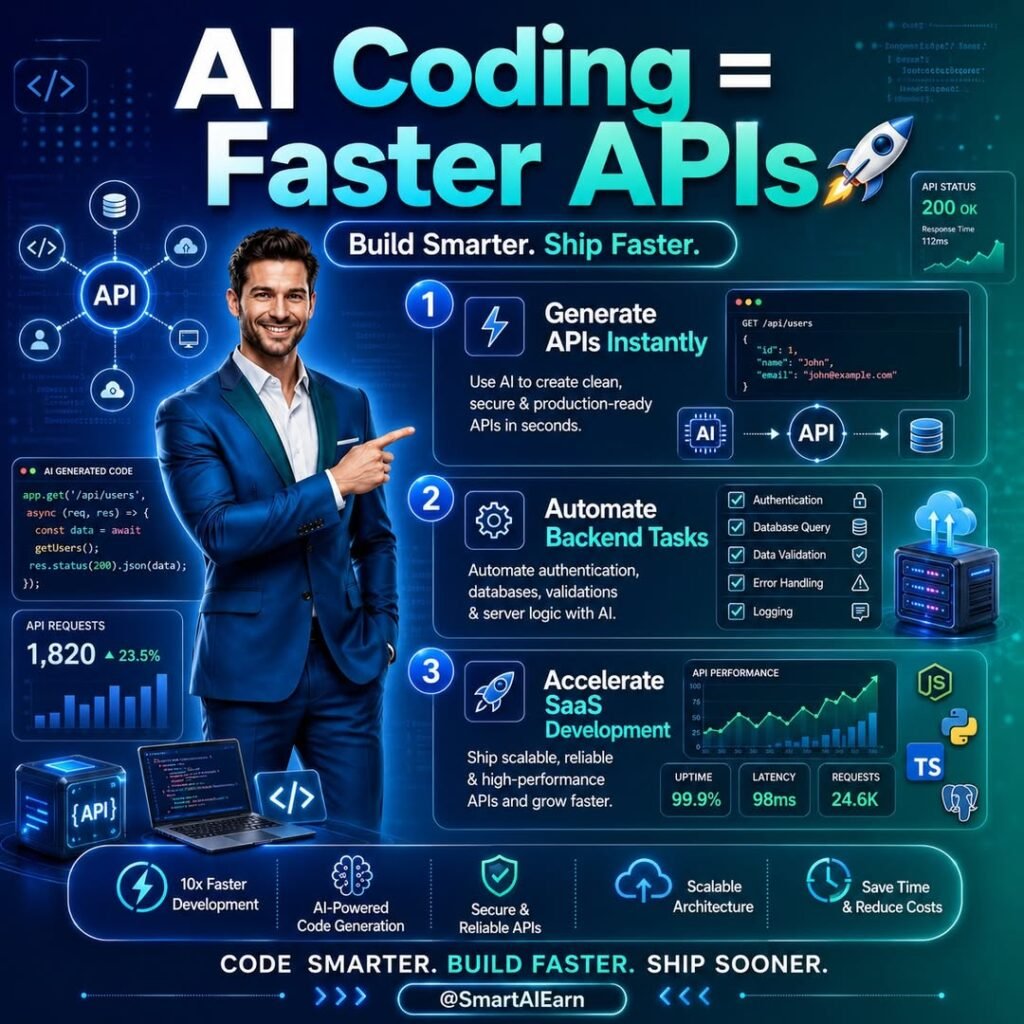
Did you know that nearly 70% of modern software projects now rely on automated assistance to meet tight deadlines? This shift is changing how teams approach development, allowing even non-technical members to launch functional applications from scratch.
By utilizing AI Coding Tools | Instantly Build APIs, your team can bypass repetitive manual tasks. These platforms empower developers to focus on high-level architecture rather than writing boilerplate code. Efficiency is no longer just a goal; it is a standard.
The rise of instant api creation allows businesses to ship production-ready software faster than ever before. Whether you are a professional engineer or a founder without a technical background, these resources bridge the gap between concept and deployment. Embracing these innovative solutions ensures your project stays ahead in a competitive market.
Key Takeaways
- Automated assistants enable non-technical teams to create functional software.
- Development speed increases significantly by reducing repetitive manual labor.
- Engineers can prioritize high-level architecture over basic syntax.
- Modern platforms allow for rapid, production-ready software deployment.
- These technologies democratize the ability to launch complex digital products.
The Evolution of AI Coding Tools and API Development
Artificial intelligence software has evolved from simple text suggestions into powerful partners for modern engineers. In the early days, developers relied on basic autocomplete features that only predicted the next few characters of a line. Today, ai coding tools have transformed the entire software development lifecycle by understanding complex project structures.
These advanced systems now act as intelligent collaborators rather than just passive editors. By interpreting natural language prompts, they can generate functional code blocks and entire application frameworks in seconds. This shift represents a massive leap forward for developers who want to build robust APIs without getting bogged down in repetitive syntax.
The transition toward agentic workflows has changed how we approach API design. Modern ai coding tools do more than write lines of code; they analyze the intent behind your request to ensure the output aligns with your specific business logic. This capability is essential for teams looking to scale their infrastructure quickly.
The rapid progression of artificial intelligence software has significantly lowered the barrier to entry for complex programming tasks. You no longer need to be an expert in every single framework to build a high-performing API. Instead, you can leverage these platforms to handle the heavy lifting while you focus on high-level architecture.
To understand why these tools are now vital, consider the core benefits they bring to the development process:
- Increased Velocity: Rapidly prototype and deploy API endpoints.
- Context Awareness: Systems that understand your entire codebase structure.
- Reduced Errors: Automated suggestions that follow industry best practices.
- Accessibility: Enabling developers of all skill levels to build sophisticated applications.
As we look toward the future, the integration of these technologies will only become more seamless. Embracing these ai coding tools is no longer optional for teams that want to remain competitive in a fast-paced digital market.
How AI Coding Tools | Instantly Build APIs for Modern Applications
Building robust APIs no longer requires hours of tedious manual boilerplate coding. Modern ai coding tools have fundamentally changed how developers approach backend architecture by providing deep insights into existing project structures.
These platforms do more than just suggest lines of code; they analyze your entire repository to understand dependencies across multiple files. By utilizing artificial intelligence software, developers can maintain high standards of quality while significantly reducing the time spent on repetitive tasks.

The shift toward instant api creation allows teams to focus on complex business logic rather than syntax. When a tool comprehends the full context of your application, it prevents common integration pitfalls that often plague manual development cycles.
Choosing the right platform is essential for long-term success. You should prioritize solutions that offer deep codebase awareness to ensure that your generated endpoints remain scalable and secure. The following table highlights the key differences between traditional methods and modern automated workflows.
| Feature | Manual Development | AI-Assisted Development |
|---|---|---|
| Code Generation | Hand-written boilerplate | Automated structure |
| Context Awareness | Limited to current file | Full repository analysis |
| Speed of Delivery | Slow and iterative | Rapid instant api creation |
| Error Handling | Manual debugging | Predictive pattern matching |
By integrating these ai coding tools into your daily routine, you create a more efficient environment for your team. This transition not only boosts productivity but also ensures that your modern applications are built on a foundation of clean, maintainable code.
Selecting the Right AI-Powered Development Solutions
Choosing the best technology stack is a vital step for teams aiming to boost their output with modern automation. When you integrate ai-powered development solutions into your existing pipeline, you must ensure they fit your current workflow seamlessly. Whether you prefer a lightweight extension in VS Code or a robust web-based environment, the right tool should feel like a natural extension of your keyboard.
Evaluating these platforms requires a focus on practical criteria that impact your daily productivity. You should prioritize tools that offer model flexibility, allowing your team to switch between different language models based on the complexity of the task. Furthermore, the ability to test code snippets before committing them to your repository is a non-negotiable feature for maintaining high software quality.
Many developers find that the most effective ai coding tools are those that support agentic task execution. This means the software does not just suggest lines of code but can handle entire functions or refactoring tasks independently. By selecting a solution that aligns with your team size and project requirements, you minimize friction and maximize the benefits of automation.
To help you make an informed decision, consider the following comparison of key features found in modern development platforms:
| Feature | Basic Assistants | Advanced AI Agents |
|---|---|---|
| IDE Integration | Limited | Full Support |
| Code Testing | Manual | Automated |
| Model Flexibility | Fixed | High |
| Task Execution | Suggestions | Autonomous |
Ultimately, the goal is to choose a platform that scales with your needs. Ease of use remains a critical factor, as a steep learning curve can hinder adoption across your engineering team. By focusing on these core metrics, you can confidently select the right tools to accelerate your development lifecycle.
Setting Up Your Environment for Automated Code Building
A well-configured environment is essential for anyone looking to streamline their programming api workflow. By preparing your workspace correctly, you ensure that your tools communicate effectively, allowing for seamless automated code building. This foundation helps you avoid common technical hurdles while boosting your overall productivity.
Modern AI coding tools now offer advanced connectivity options, such as the Zapier MCP integration. This feature allows your AI assistant to take direct actions in external applications without you ever needing to leave your IDE. Imagine updating a project board or sending a notification automatically while you focus on writing core logic.

Maintaining a clean and organized workspace is just as important as the tools you choose. When your file structure is logical, AI agents can navigate your codebase with much higher accuracy. This clarity prevents the AI from making unnecessary errors during the automated code building process, saving you valuable time on manual reviews.
Before you begin, ensure your development environment meets the necessary prerequisites for a robust programming api integration. A stable connection and updated dependencies are vital for long-term success. The following table outlines the key components you should verify before starting your next project.
| Component | Requirement | Benefit |
|---|---|---|
| IDE Version | Latest Stable | Better Plugin Support |
| API Keys | Securely Stored | Safe External Access |
| Environment Variables | Properly Configured | Consistent Deployment |
| Dependency Manager | Active & Updated | Reduced Build Errors |
Step One: Defining API Requirements with Natural Language Prompts
Success in automated development begins long before the first line of code is written. When you use AI tools to build APIs, the quality of the output depends entirely on the clarity of your input. By establishing a solid foundation through natural language, you save time and prevent unnecessary rework.
Translating Business Logic into Technical Specifications
Bridging the gap between a business idea and a technical schema is a vital skill. Modern platforms like Replit excel at this by using an Agent that acts as a bridge between your vision and the machine. Instead of guessing your needs, the Agent asks clarifying questions to ensure the plan is fully understood before it starts building.
This interactive process helps you define key elements such as data endpoints, request methods, and authentication requirements. By answering these questions thoroughly, you provide the AI with the context it needs to generate a functional architecture. Clear communication is the ultimate shortcut to a successful deployment.
“The quality of your AI-generated code is a direct reflection of the precision found in your initial requirements.”
Refining Prompts for Better Code Accuracy
Even with advanced tools, your ability to refine prompts determines the final accuracy of the code. If the initial output is not quite right, you should avoid vague feedback. Instead, provide specific constraints and structural expectations to guide the model toward the desired result.
To improve your success rate, consider these best practices when interacting with your AI assistant:
- Be specific about data types: Clearly define the expected input and output formats for every endpoint.
- Define error handling: Explicitly state how the API should respond to invalid requests or missing data.
- Set architectural boundaries: Mention if you prefer a specific framework or a modular folder structure.
- Iterate with purpose: Use the feedback loop to clarify one specific component at a time rather than asking for a total rewrite.
By following these steps, you minimize the need for manual corrections later in the process. Mastering the art of the prompt allows you to focus on high-level logic while the AI handles the heavy lifting of syntax and boilerplate generation.
Step Two: Generating Boilerplate Code Using Machine Learning APIs
Modern development relies heavily on machine learning apis to automate the heavy lifting of project scaffolding. By offloading the repetitive task of writing boilerplate code, developers can focus their energy on complex business logic and unique feature sets. This shift not only saves time but also ensures that your project starts with a clean, standardized architecture.

Leveraging GitHub Copilot for Rapid Structure Creation
GitHub Copilot acts as a powerful extension directly inside your existing code editor. It provides real-time inline suggestions, a helpful chat interface, and the ability to perform multi-file edits seamlessly. These features allow you to generate entire directory structures and configuration files in seconds rather than hours.
By utilizing these code generation tools, you can maintain high levels of consistency across your entire codebase. When every developer on your team uses the same automated foundation, the risk of configuration drift decreases significantly. This approach is essential for scaling modern applications efficiently.
Utilizing Cursor for Context-Aware API Generation
Cursor takes automation a step further by offering deep, context-aware insights into your specific project requirements. It understands the relationships between your files, allowing it to suggest highly relevant code snippets that fit your existing architecture perfectly. This level of intelligence makes it easier to build APIs that adhere to industry best practices from the very first line of code.
The following table highlights the core differences between these two popular solutions to help you choose the right fit for your workflow:
| Feature | GitHub Copilot | Cursor |
|---|---|---|
| Primary Interface | Editor Extension | Standalone IDE |
| Context Awareness | Project-wide | Deep codebase analysis |
| Best Use Case | Rapid boilerplate | Complex refactoring |
| Integration | VS Code/JetBrains | Built-in |
Ultimately, integrating these tools into your daily routine transforms how you approach API development. You spend less time on tedious manual setup and more time delivering value to your users. Embracing these technologies is a smart move for any team looking to stay competitive in a fast-paced market.
Step Three: Integrating Database Schemas and Authentication Logic
Once your boilerplate code is ready, the next phase involves connecting your database and locking down your endpoints. This stage is critical for ensuring that your application handles information correctly and stays protected from unauthorized access.
Modern AI tools like Claude Code can significantly accelerate this process. These assistants explore your codebase to trace data flow, identify potential bugs, and even suggest structural fixes before you commit to Git.
Mapping Data Models with AI Assistance
Mapping your database schema requires a deep understanding of how your application entities relate to one another. AI assistants excel at translating high-level requirements into optimized SQL or NoSQL structures.
By providing clear context about your data needs, you allow the AI to generate schema definitions that are both scalable and efficient. It is important to review these suggestions to ensure they align with your specific performance goals.
Always verify that the generated models follow standard normalization practices. Human oversight remains essential here to catch edge cases that an automated tool might overlook during the initial generation phase.
Implementing Secure OAuth and JWT Flows
Security is the backbone of any professional API. Implementing robust authentication protocols like OAuth and JSON Web Tokens (JWT) is a task where precision is non-negotiable.
AI can draft the boilerplate for your authentication middleware, but you must ensure the logic is strictly compliant with security best practices. Never deploy generated security code without a thorough manual audit to prevent vulnerabilities.
The following table outlines the primary differences between common authentication methods to help you choose the right approach for your project:
| Protocol | Primary Use Case | Security Level | Complexity |
|---|---|---|---|
| JWT | Stateless API Auth | High | Moderate |
| OAuth 2.0 | Third-party Access | Very High | High |
| API Keys | Simple Service Access | Low | Low |
By combining the speed of AI-assisted generation with your own expert review, you create a secure and scalable foundation. This balanced approach protects user data while maintaining a high velocity in your development cycle.
Step Four: Testing and Debugging AI-Generated Endpoints
Building APIs with AI is fast, but validating that code is where true reliability is forged. While modern code generation tools significantly reduce manual effort, they are not immune to logic errors. A rigorous testing strategy ensures that your endpoints perform exactly as expected under various conditions.
By automating your review cycles, you can catch potential issues before they reach your production environment. This proactive approach allows development teams to deliver high-quality software at a much faster pace.
Automating Unit Tests for API Reliability
Automated testing is the backbone of a stable API. When you rely on code generation tools, you should immediately integrate unit tests to verify every endpoint’s response. Frameworks like Jest, PyTest, or Mocha can be configured to run automatically whenever new code is pushed to your repository.
Consistency is key when dealing with automated outputs. By defining clear success criteria for your API responses, you ensure that the generated logic remains robust even as your application scales. This practice minimizes the risk of runtime errors that often plague complex systems.

“Testing is not a phase; it is a continuous process of building confidence in your code.”
Identifying and Fixing Hallucinated Code Patterns
Sometimes, code generation tools may produce “hallucinations,” which are snippets of code that look correct but contain subtle logic flaws. These patterns often manifest as incorrect data handling or insecure authentication flows. You must manually audit these sections to ensure they align with your specific business requirements.
To fix these issues, start by isolating the problematic endpoint and running targeted integration tests. If the AI suggests a library or method that seems unfamiliar, verify it against official documentation before implementation. Security and performance should always take priority over the speed of initial generation.
By maintaining a critical eye, you turn AI assistance into a powerful asset rather than a liability. Debugging is an essential skill that ensures your final product is both secure and maintainable for the long term.
Best Practices for Maintaining AI-Generated Programming API Code
When you build a programming api with AI, the real work begins after the initial code generation. While automation speeds up the creation process, it does not replace the need for disciplined software engineering practices. Treating machine-generated output with the same rigor as human-written code is essential to prevent long-term technical debt.
Version Control Strategies for AI-Assisted Projects
Effective version control is the backbone of any stable development environment. When working with AI tools, you should commit code in small, logical chunks rather than dumping large blocks of generated text at once. This practice makes it significantly easier to track changes and identify exactly where a specific feature was introduced.
Branching strategies are equally vital for maintaining a clean history. Always use feature branches for AI-generated updates to ensure that your main codebase remains stable. By reviewing every pull request, you ensure that the AI has not introduced redundant logic or security gaps into your programming api.
“Quality is not an act, it is a habit. Even when the code is written by a machine, the responsibility for its performance and security rests entirely with the human developer.”
Ensuring Long-Term Codebase Maintainability
To keep your project healthy, you must prioritize modularity and clear documentation. AI tools often generate monolithic blocks of code that can be difficult to debug later. You should manually refactor these outputs into smaller, reusable functions to improve readability and testing.
Maintaining a consistent documentation style is also critical for future-proofing your work. Since AI can sometimes produce code that lacks context, adding descriptive comments helps other developers understand the intent behind specific endpoints. The following table highlights the differences between standard and AI-assisted maintenance workflows.
| Maintenance Task | Manual Approach | AI-Assisted Approach |
|---|---|---|
| Code Review | Peer-led inspection | Automated linting + Human audit |
| Documentation | Manual updates | AI-generated summaries + Human edit |
| Refactoring | Scheduled sprints | Continuous modularization |
| Testing | Manual test cases | Automated unit test generation |
By following these structured steps, you ensure that your programming api remains robust and scalable. Consistent human oversight transforms AI-generated code from a temporary solution into a reliable, long-term asset for your organization.
Overcoming Common Challenges in Automated Development Platforms
Adopting ai-powered development solutions requires a strategic approach to handle potential security and maintenance risks. While these tools significantly boost output, they also introduce complexities that can catch unprepared teams off guard. By staying vigilant, developers can harness the power of automation without compromising their project integrity.

Addressing Security Vulnerabilities in Generated Code
Security is often the primary concern when integrating new technology into a production environment. Organizations should prioritize privacy settings to ensure that proprietary logic remains confidential. It is highly recommended to prefer local or hybrid models when working with sensitive codebases to prevent accidental data leaks.
Using these automated development platforms safely means treating AI-generated snippets as untrusted input. Always perform thorough code reviews and run automated security scans on any output before merging it into your main branch. This extra layer of verification acts as a critical safeguard for your intellectual property.
Managing Dependencies and API Versioning
Maintaining a clean codebase becomes difficult when AI tools suggest various libraries or outdated API versions. Developers must actively monitor the dependencies introduced by these assistants to avoid dependency hell. Establishing a strict version control policy ensures that your project remains stable as it grows.
Effective management involves pinning specific versions of libraries rather than relying on generic suggestions. Regularly audit your project configuration files to identify and remove redundant or deprecated code patterns. By maintaining this level of oversight, you ensure that your ai-powered development solutions continue to provide value without creating technical debt.
Conclusion
Modern software engineering relies on the rapid evolution of intelligent tools to keep pace with market demands. Integrating AI into your workflow changes how you build and maintain complex systems.
You now possess the knowledge to leverage platforms like GitHub Copilot and Cursor to streamline your API creation. These technologies offer a clear path toward higher productivity and cleaner codebases.
Start your journey by testing these tools on small pilot projects within your team. Measuring the impact on your specific development cycle provides valuable insights into long-term efficiency gains.
Staying competitive requires a willingness to adapt to new methods of writing and managing software. Your commitment to mastering these automated platforms will define your success in the coming years.
Take the next step today by applying these strategies to your current architecture. The shift toward AI-assisted programming is a vital move for any developer aiming to lead in this fast-paced industry.
FAQ
How do ai coding tools actually speed up the development of a programming api?
Is instant api creation safe for production environments?
What are the best artificial intelligence software options for a professional engineering team?
Can I use machine learning apis to build a backend even if I am not an expert coder?
How does automated code building handle complex database integrations?
What should I do if the code generation tools produce errors or “hallucinations”?
Do these automated development platforms support multiple programming languages?
How can I ensure my code remains maintainable when using ai-powered development solutions?
Build Smarter Content Systems with Practical Mini-Guides
Short, actionable digital guides designed to help creators, bloggers, affiliate marketers, and online business owners learn faster, take action sooner, and grow with more clarity.

Pinterest Excellence Playbook
Evergreen traffic + Pinterest SEO. A practical Pinterest growth blueprint covering platform positioning, profile SEO, branding consistency, content planning, pin design, publishing cadence, analytics, monetization, and weekly execution.
View Guide
Google Web Story Excellence Playbook
Visual SEO + mobile traffic. A complete mini guide for planning, designing, optimizing, publishing, and monetizing Google Web Stories that can rank in Search and Google Discover.
View Guide
YouTube Excellence Playbook
Channel growth + SEO system. A practical YouTube growth blueprint covering channel strategy, branding, content planning, YouTube SEO, asset dimensions, analytics, engagement, technical quality, monetization, safety, and weekly workflow.
View Guide
Instagram Excellence Playbook
Profile growth + engagement. A complete Instagram growth blueprint covering profile optimization, content strategy, posting system, SEO, engagement, and monetization.
View Guide
Facebook Excellence Playbook
Reach + content strategy. A complete Facebook growth blueprint covering page positioning, branding, content planning, posting strategy, SEO, analytics, engagement, monetization, and compliance.
View Guide🚀 Want More Practical Digital Resources?
Explore SmartResourceVault for AI prompts, templates, planners, trackers, mini-guides, audio resources, and bundles built for faster execution and everyday growth.
📘 Browse Mini Guides »💼 Build Your AI-Powered Income
Turn your ideas into income with these bestselling guides:


🌟 Ready to Build Your AI Income Stream?
You’ve learned the tools — now master the strategies!
Explore our exclusive AI Side Hustle & Passive Income eBooks to start earning smarter with ChatGPT, Canva, and automation tools.